Neo’s Character Flaw

A couple of posts ago I mentioned that I’d had to put timelining of the four-story SF series I’m working on on hold, because I’d managed to bugger up the way my protagonist’s major problem (her wound) got resolved at the end of the first story. I’d like to explain that a bit, at least the way it was explained to me.

Characters have flaws, and they have wounds. Flaws are usually consequences of wounds. When it comes to developing a series, the wound will usually carry on through the entire series. I used Harry Potter as an example; his wound is that Voldemort murdered his parents, and that doesn’t get sorted out until the defeat of Voldemort at the end of the last book. However, Harry has a series of flaws: self-doubt, arrogance, the worry that he’s a new Voldemort in the making, and so on. And each of these provides a background for one of the books, and is resolved by the end of that book.

So while wounds and flaws are related, they’re distinct.

But there’s more to flaws than just setting them up at the start of a story and resolving them at the end. Far better is to make the resolution of the flaw vital to the resolution of the story as a whole.

Here’s an example: Neo in The Matrix. Neo’s flaw is that he won’t accept that he is The One. In terms of wants and needs, he wants to believe that he’s not special (and the Oracle reinforces this when she tells him he isn’t). But he needs to believe, because until he does he doesn’t stand a chance against Agent Smith. So his wants and needs conflict.

So then comes the fight with Smith, and Neo dies in the Matrix. BUT… at that point, Trinity tells Neo’s real-world corpse that she loves him and that means he must be The One, because the Oracle told her so. And now Neo believes; he knows he is The One. He is reborn with world-bending powers, and can take on Smith with one hand behind his back.

tumblr_msp1fjIFNp1sbavuuo1_500

In the first story of the series I’m working on at the moment, my protagonist realises that what she thought she wanted was a phantom, and that what she really needed the whole time is about to be taken away by the bad guy. This happens when the bad guy himself tells her that he’s going to take that thing from her, not realising that he just gave her a reason to fight as hard as she ever has, and doomed himself in the process.

Hopefully I’ve shed a little light on how wants and needs can tie into flaws in a way that all comes together at the end of a story, in such a way as to make for a more powerful tale.

Giving #LiteraryAgents a Bad Rap

agent

Several times on these pages I’ve said bad things about agents. And then, a few days ago, I was told something that explained a lot. As a result, I take it all back. I’m genuinely sorry, agents.

The thing that bugged me was that every rejection I’ve ever had was a form rejection with no hints as to why the query was rejected; not even just a couple of words to say that the writing stinks, or the synopsis stinks, or anything else. Nothing that could be used as guidance for creating a better query, or a better story, or better characters. I guess I assumed that agents had even just half a minute to write a few words.

Bad assumption.

At the very last meeting of the summer writing workshop that I’ve mentioned here a few times, the guest speaker talked about publishing and agents. And she mentioned something that I guess should have been obvious.

There was a time when sending a query meant typing out the query on actual paper, and copying (or photocopying) the requested number of pages from the typescript, and maybe writing out a synopsis; and then putting all that together and sticking it in a big envelope and taking it to the post office and mailing it. In other words, it took some actual effort, and you had to be pretty serious about doing it.

No more. These days you can slap together all that material on a laptop with a bit of copy’n’paste, and attach the first ten or twenty pages to an email and click Send, all in the time it takes to make a cup of tea.

It’s almost too easy. And as a result, agents get a huge number of queries. Huge. Like, thousands every week. I knew that the Internet would automatically make that kind of email traffic inevitable, but I didn’t realise just how much traffic we’re talking about here. And I can imagine that the majority of those queries are so completely awful that they go straight in the trash. Agents have to deal with those as well as doing the whole agent thang—representing their existing authors, hawking their books to publishers, and everything else they have to do.

So it’s no wonder that when it comes to dealing with a never-ending flood of queries—hundreds of them every single day—agents really don’t have the time to write out individual responses to every one. Hence, form rejections and nothing more.

So, agents, I understand now. And I’m sorry I said all those bad things about you. I won’t say them again, honest.

There is one thing, though: our guest speaker mentioned agents that don’t even bother with the form rejections and in fact don’t bother to respond at all. She thought that was unjustified and unprofessional. I agree. When I look on QueryTracker and see agents with response rates in the four- or five-percent range and lower, that bugs me. In general I don’t bother sending queries to those agents at all (I made one exception in the case of Smoke & Mirrors, but I probably won’t do that again). But if you’re one of those agents, maybe you have a perfectly good reason for not responding; if so, I for one would like to hear it, and if it makes sense I’ll have your back on that, too.

Back to story building on that SF series I’m working. Until next time…

Spoke Too Soon

A couple of posts back I mentioned that I’d got my storyline to the point where I’d started working on the timeline.

As it turns out, I got a little bit ahead of myself. I’ve had to stop working on the timeline because I realised I’d made a mistake with the story. And boy, is it a doozy.

The way I had the story set up, the first of the four stories starts with my protagonist having a problem. And the way the story went, that problem had been worked out by the end of that same first story.

That doesn’t work; it would mean she’d need a new problem to take into the second story. And if she’d already dealt with the biggest obstacle in her life, then what possible hurdles could she have in the second story that would even come close to that?

Here’s a couple of examples of the kind of thing I’m talking about; this should make it clearer.

First, look at Harry Potter. His problem is Voldemort. And while he wins fights against The Dark Lord in each book, Harry doesn’t actually beat him for good until the final battle at the end of the last book.

Another example: Neo’s fighting the machines and we find that out early in The Matrix, but he doesn’t end the war until the end of the third and last movie.

Last example: Frodo encounters the One Ring not far into The Fellowship of the Ring, and the story only ends when he destroys the ring—and Sauron—at the end of The Return of the King.

Ringfrodo

You get the picture. I’ve had to go back to my plotting and change things so that the problem my protagonist has at the beginning of the first book carries her through a series of adventures all the way through the complete set of four stories. And that in turn has meant adding in a bucketload of back story to support things—and the rabbit hole gets deeper as she learns more about the truth behind her original troubles a little at a time; she only finds out the complete details close to the end of the last story. It also means that what was to be the second story in the series will be pretty much torn down and replaced, and the way things are going it’s not impossible that I’ll need a fifth book to complete the whole tale.

So at the moment timelining is suspended until I get all the details worked out and written down. What I thought was going to take a few days is now looking like it’s going to take a few weeks at least. This thing is becoming a monster.

I’ll post more on this as I progress.


Eclipse Pics

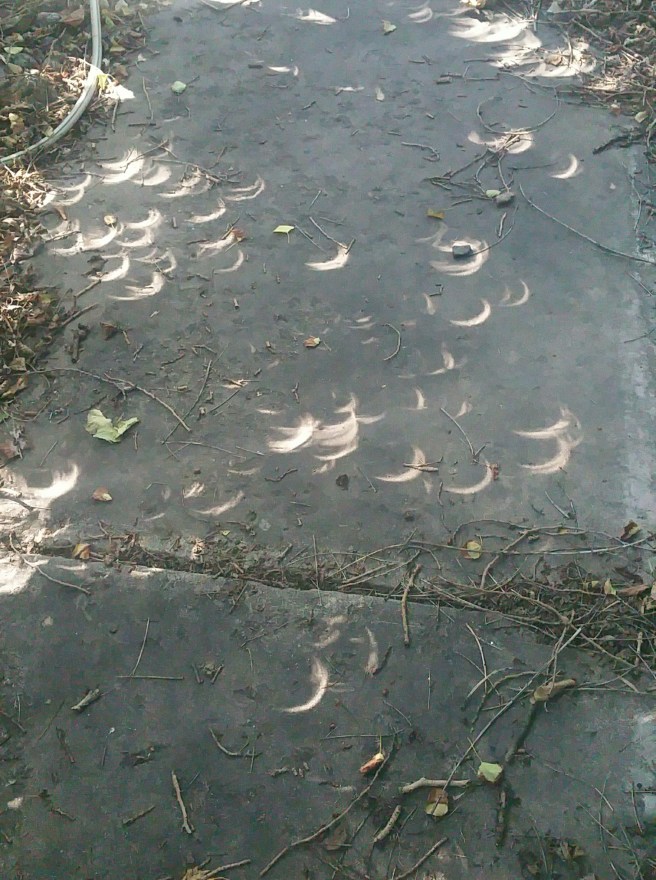
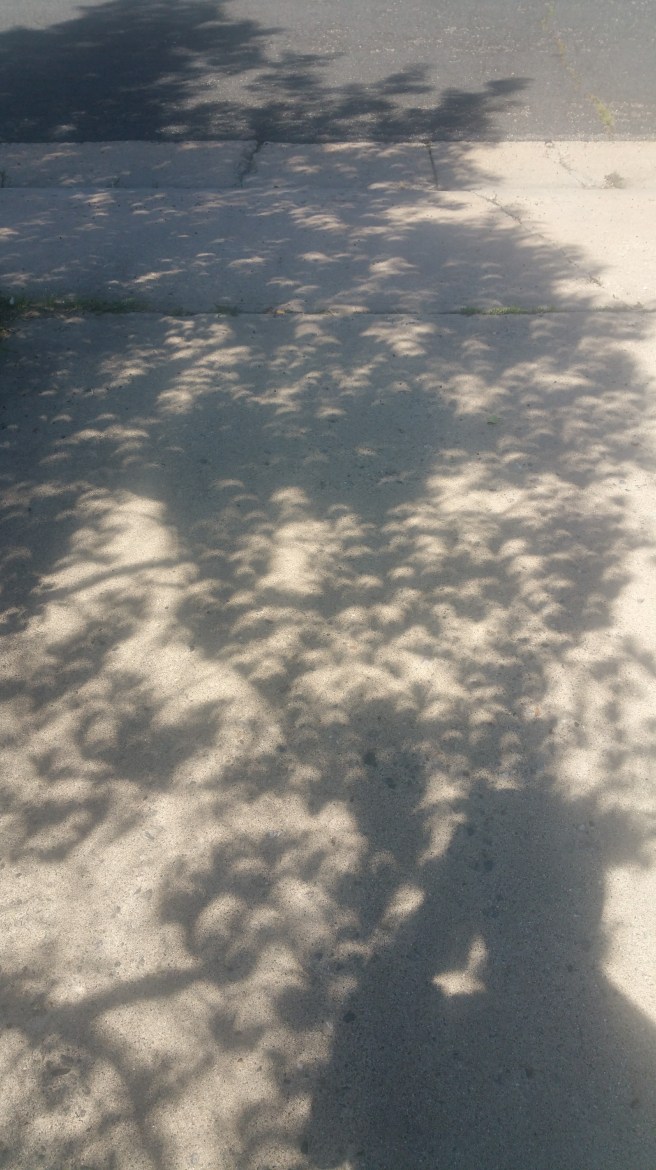
We didn’t get a total eclipse here in northern Colorado, but it came close—about 94% covered, according to one source. I wasn’t about to point my eyes or a camera at the sun to get pictures, though.

I was thinking about doing what I’ve done before: set up a pair of binoculars, and use a mirror behind one eyepiece to project an image of  the sun onto a screen or a light-coloured wall. With 7×50 binoculars you can get a projected image three feet across pretty easily. It works for looking at sunspots, too. The hardest part is getting the binoculars pointing at the sun safely (that is, without looking through the things—I don’t need to tell anyone how stupid that would be) and keeping them pointing at the sun as it moves.

But I didn’t take the time for that. Instead, I just got some pictures of the crescent shapes on the ground under the trees, which are still pretty cool.

IMG_20170821_11423420170821_11455420170821_111955

Working On The Latest Book – #AmWriting

I’ve made a start on turning my story notes for the as-yet-untitled SF novel(s) into a timeline. The reason for the (s) in novel(s) is that it looks like each of the four stories is going to end up being novel length, so they’ll probably get published as four separate books. But it’s early days yet; I’ll see how that works out.

And I really must try to think up a good working title.

Seventeen scenes done so far. That might not sound like much but there’s quite a lot of braining that goes into it; it can be pretty tough going. I’m taking a break from it for a while; going to watch a bit of Penny Dreadful.

More Books Are Good For Your Brain

In the previous post I promoted my own books a bit. And since I mentioned it, here they are again: https://petefordwriter.com/books

And I promised in that post that I’d promote a handful of other authors. No big names here; you guys don’t need my help to get your books out there. The intention here is to try to give a leg up to a few people with some excellent books that you might not know about.

So let’s start off with Craig Hallam, a fellow Brit. I read Greaveburn a while back and it’s one of those books I can’t help but pick up and read again every so often. (I think I’ve read it four times now.) He also has the Alan Shaw stories, and more. Check his work out here: https://craighallam.wordpress.com/books/

Now I must mention the great authors at my own publisher. While I don’t claim to have read everyone I have read Aly Grauer, Ben Ireland, Russell Smith, and several others. Don’t miss out on some outstanding stories: http://www.xchylerpublishing.com/our-books/

That’s all I have time for today; I’m eager to get on with timelining my own next book. So until next time . . .

Books Are Good For Your Brain

Something I’ve been told I don’t do often enough (tooting your own horn feels wrong, somehow): promoting my books. You can find all the links here:

https://petefordwriter.com/books

That’s it for now (the day-job is keeping me too busy to do more at the moment). In a future post (soon . . . very soon) the plan is to promote some books by other lesser-known authors. Watch this space.

Complicity

I was at my local pharmacy earlier today, picking up a prescription, and as I was leaving I saw a big grey-haired guy. He looked about seventy-ish. He was wearing a military baseball cap—US Navy, I think, but I was a bit too far away to be sure—and everything about him said Veteran with a capital V. Looking at him, I’m thinking that this guy’s probably not quite old enough to have served in WWII. But I’m going to guess that there’s a good chance he had parents and possibly grandparents who fought nazis in that war.

And then he climbed into a big Chevy truck and I couldn’t help but notice a blue and white TRUMP sticker in the back window.

After everything that’s happened over the last few days, here’s someone who continues to support Trump after it’s plain to anyone keeping up with the news that he’s on the side of the nazis behind what happened in Charlottesville, and in fact nazis everywhere.

Just to be clear, since I haven’t heard a lot of people reminding us why we say nazis are evil: Those nazis in WWII were the ones that said straight white people like us are the best people and that gives us the right to murder the jews, and the gays, and blacks, and the disabled, and the mentally ill, and anyone else we think is inferior, which is basically everyone that isn’t us. And these nazis today—you can call them White Nationalists or Alt-Right if you like, but they’re still nazis—are just the same old shit in a dapper new wrapper. Same agenda. Same evil.

So here’s a guy who looks for all the world like a veteran, who should know better than most just how evil nazis are. Yet he’s supporting Trump, the nazi sympathiser. The nazi enabler. The nazi stooge who won’t say a word to condemn nazis because nazis got him into the White House and he doesn’t dare piss them off.

And in continuing to support Trump, this veteran guy is betraying the people who fought and in many cases died in WWII to stop the same damned nazis.

So I say to you: If you’re still supporting Trump after what’s been going on, then that makes you a nazi sympathizer too. If you can do that, knowing what the nazis were then and still are today, you should be ashamed of yourself.

How Chuck Wendig Edits A Novel

NOT my words today. I just read this and had to share. Click this link right now:

http://terribleminds.com/ramble/2013/01/08/how-chuck-wendig-edits-a-novel/

Read and inwardly digest, gentle reader.

#AmWriting . . . or am I?

THE thing with the Twitter hashtags is that they can often be a bit misleading. At this moment I’m working on the Untitled Sci Fi Novel project, but at the moment I’m not actually writing anything.

This project is four stories back to back, with the same central  character, set in the same universe. Each story is self-contained, but there’s a separate story arc that runs across all four. I’m using my own process (as described in Finish Your Book) and in a particular way; I’m developing all four stories in parallel, rather than doing the first down to scene level before I move on to the second, and so on. Right now I have the top-level structure for the first three stories pretty much done, and I’m getting the fourth one down; it’s coming along well, and I should have that finished in a couple more days.

In other words, I’m world-building, and I’m developing the story, and I’m developing the characters. But I’m not writing anything other than my notes.

And that leads to something that is probably extremely trivial but bugs me nonetheless. You see, Twitter has hashtags like #AmWriting, and #AmEditing. But I don’t see #AmWorldBuilding, or #AmDevelopingCharacters, or #AmThinkingAboutAStoryIdea.

So I gave up on those hashtags. I don’t use anything but #AmWriting. If I’m in the car, thinking about a story idea while doing 75 down I-25, then I’m writing. I’m writing if I’m making notes about a character, or working on scenes, or building the timeline. Basically, if I’m doing anything at all that’s moving a story from the first seed of an idea to actual ink (or e-ink) that someone can read, then I’m writing.

And on that note, I have to run out to the store. But you can bet I’ll be “writing” at the same time.

Until next time . . .

p.s. A few words about the events at UVA:

  • They’re not “alt-right”. The term alt-right was invented by a nazi to describe nazis without calling them nazis. These c*nts are giving nazi salutes and carrying swastika flags. They’re nazis. Call them nazis.
  • So far about 99% of the tweets I’ve seen are condemning what’s been going on. That’s an encouraging sign that most people are against these bigoted, spoiled, white trash. I take some comfort in that.
  • Meanwhile, as of about sixty seconds ago, Comrade Trump hasn’t tweeted a damn thing about it. Fifteen hours without a tweet has to be some kind of record for him. I’m wondering what mealy-mouthed bullshit he’s going to spout when he does bother to say something.