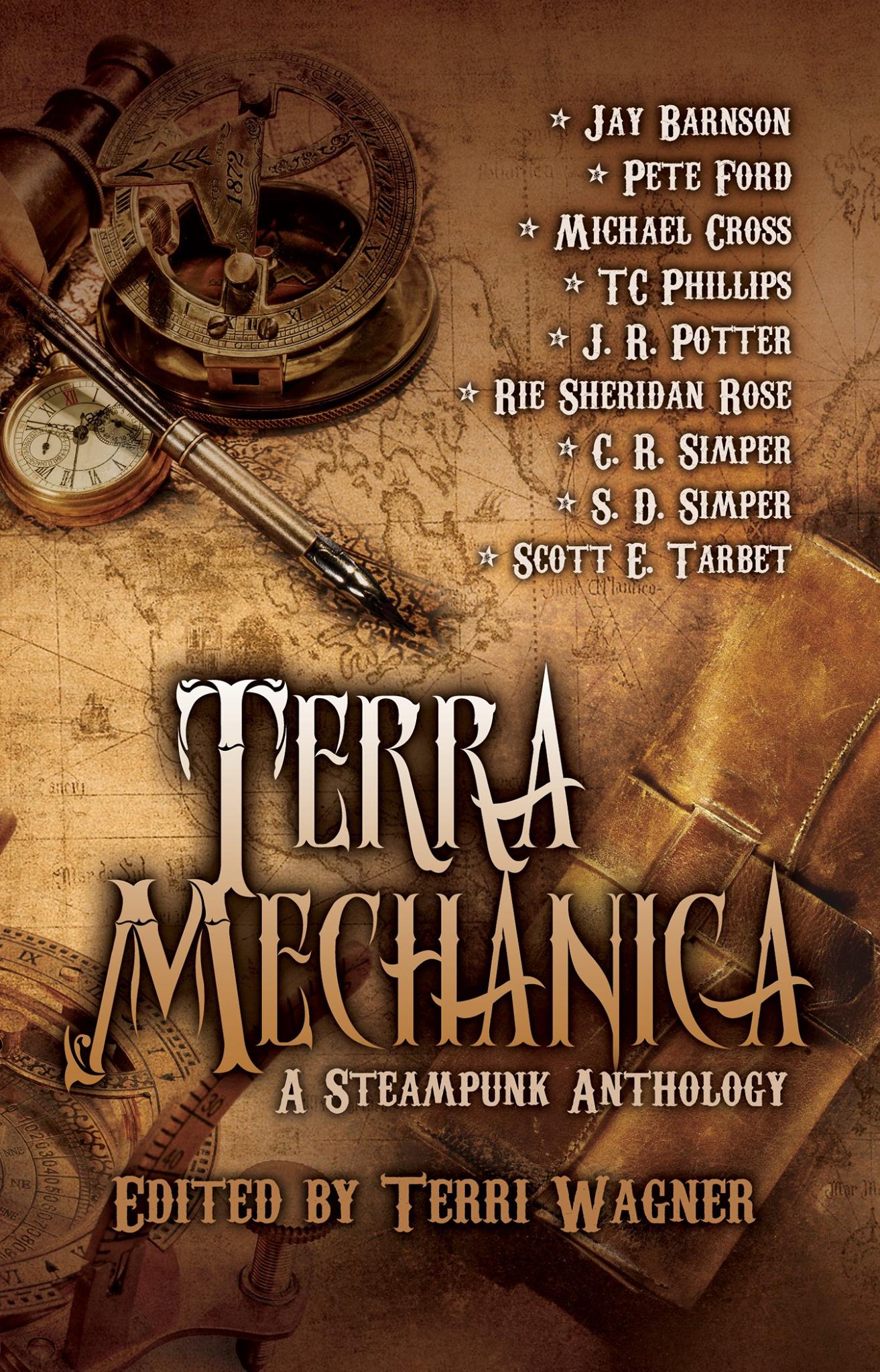
Terra Mechanica, the latest Steampunk anthology from Xchyler Publishing, hits shelves on May 31. And now . . . the cover!
Woo Hoo!
9.5 on the WTF-o-meter

Terra Mechanica, the latest Steampunk anthology from Xchyler Publishing, hits shelves on May 31. And now . . . the cover!
Woo Hoo!
For those of you that didn’t already know, I smoke. Not heavily—I’m not a brown-fingered fifty-a-day kind of guy—but I’ve been a smoker for a long, long time.
And just like many others, I’ve tried to pack it in. More than once. (Just saying that reminds me of the old joke: giving up smoking’s easy; I’ve done it dozens of times.)
These days, of course, for us addicts there’s an alternative to giving up cold turkey style, in the form of electronic cigarettes. Which I think is a bit of a misnomer, actually. There’s a battery, and a heating element that vaporises the liquid carrying the nicotine; that, to my mind, makes them electric, like an electric fire or an electric eel. Electronic makes me think of microprocessors and LEDs. Well, no doubt many e-cigs contain microprocessors and LEDs, so perhaps it’s right to call them electronic, after all. It just seems a little odd, that’s all. (Maybe it’s just me. It’s been a long week.)
To get back to the point, if you can’t stop being a miserable slave to the evil weed, you can at least try the e-cigs. Nobody’s going to say it’s as good as giving up altogether; it’s still nicotine, after all. But then, it’s just the nicotine. No smoke, no tars, no smelling like an old ashtray. And since most of the health problems associated with the coffin nails are consequences of the smoke and tars, surely the e-cig option is an improvement, right?

So, I thought I’d give them a go, if only to try to reduce some of the health risks. Over the last month or three I’ve tried a couple of alternatives, and I thought I’d write up something of my results.
The first one I tried was called a Tsunami. That’s the chrome and plastic one on the left in the photo. It seemed to work pretty well; you buy the liquid in little bottles and you fill the reservoir. The problem is that’s not always convenient (you can get some funny looks when you do that on your office desk, for example), and it can be messy. And it was relatively expensive—it set me back something like $65. But the big downside for me was that it just didn’t provide the kick a real cig does, and as a result I still had the craving to burn some real tobacco.
But I was (and am) convinced that switching would be preferable to staying on the smokes, so when I saw the Swisher e-cig I decided to give that a chance. This is the middle one in the photo. This kind has a rechargeable battery (the white part) and a disposable cartridge containing the nicotine liquid (the tan part), and it looks like a slightly oversized cigarette; it costs about $20 and for that you get the battery, a handy USB charger and one cartridge. The end lights up red when you take a puff, and that tells you it’s working. When the light blinks, either the cartridge is getting low or the battery needs recharging. Cartridges just screw into the battery, making them a lot more convenient (and less messy) than the fill-it-yourself type. But again, I still wasn’t getting that kick, and I was beginning to think either I wasn’t doing it right (with e-cigs you need to take longer, slower puffs to give the heating element time to get up to temperature), or maybe I just hadn’t found the right kind of e-cig yet.
The other day I happened across the Vuse, and I think I’ve finally found what I’ve been looking for. This is the one on the right of the photo. The chrome part is the battery, and the black part is the cartridge. The Vuse comes with a handy USB charger, so it’s very like the Swisher—but there are a couple of very important differences. First, at $10 for the battery, charger, and one get-you-started cartridge, it’s relatively cheap (cartridges come in packs of two for around $7, and they say one cartridge lasts about as long as a pack of cigarettes). Second, the light at the end lights up white instead of red. Big deal, I hear you say—but I haven’t got to the good part yet: when it blinks white, that means the cartridge is getting close to needing replacement, and when it blinks red, the battery needs charging. Knowing the difference means you don’t throw out a good cartridge by mistake when you only needed to charge the battery. Other e-cigs don’t make it easy to tell the difference, so while this might seem like a small thing it’s actually a huge benefit. But the big, big difference is the actual vaping experience; the very first puff had a strength to it that the others didn’t, and I’ve found that it actually has enough of a nicotine blast to blow away the craving for a “real” cig. The downside: from what I’ve been able to find out, you can’t buy them outside Colorado (at least, not in retail stores—maybe you can buy them online, though).
As I mentioned, I only found the Vuse the day before yesterday. So I’ll see how this goes, and I might write up a bit more in a couple of weeks to let you, gentle reader, know how it’s working out.
Until next time . . .
That paranormal short story you’ve written/partly written/been thinking about? Its time has come, because today Xchyler Publishing opens its doors to submissions for the FALL PARANORMAL SHORT STORY CONTEST. Click the link for details!

Why is it that we writers have problems explaining to others that we’re trying to write? Why is it that other people just don’t understand? I think I might have an answer. Take a look at this:
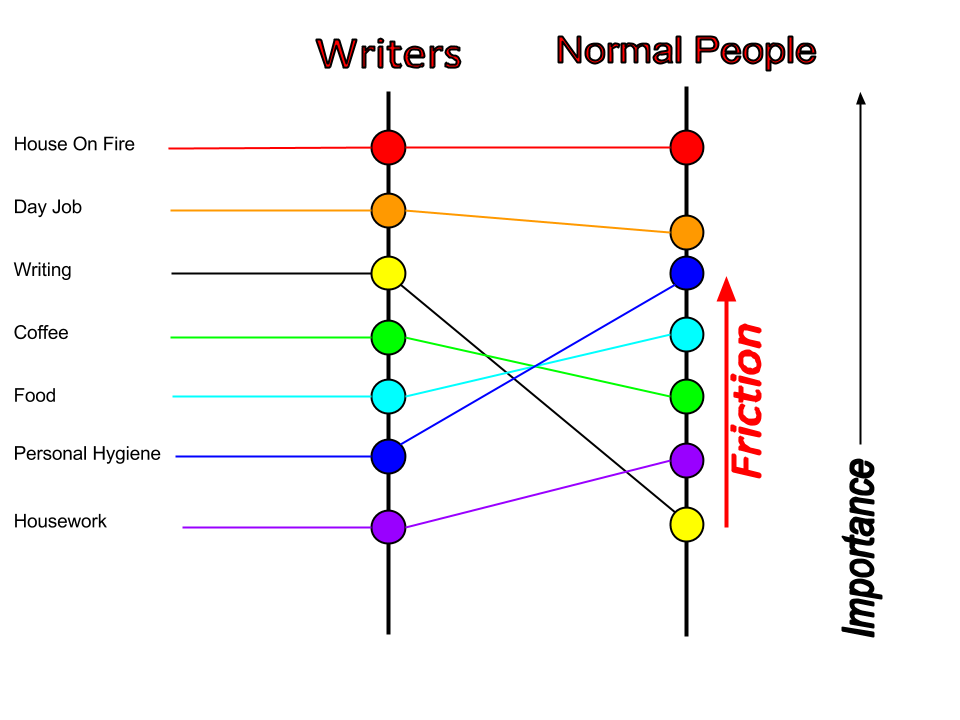
On the left, we have a list of important things around us in daily life—for example, Day Job, Food, Coffee, and (of course) Writing. And they’re arranged here in the order many writers would agree with. The most important things are at the top, so Writing is just below the Day Job (marginally more important because it pays for the stuff you need to write—computer and software, or a typewriter, or pens and paper, or parchment and quills; they all cost cash), and dealing with a burning house is more important than that—if only because a burned-out house means you have to write in your local Starbucks, which might not be too comfortable (their appalling choice of ambient music being a real concentration killer, and all that).
So-called “Normal” people, of course, have their priorities all screwed up, as can be seen from the line on the right. To them, Food is more important than Coffee, for example. But the real problem for us is that Writing is way, way down on their list of priorities. Yes, this means that to non-writers, Food is more important than Writing. Hard to believe, I know, but then these Normal People are a weird bunch. (Note that the Day Job is at a slightly lower priority for the Normal Person; that’s because your Day Job is not as important to them as their Day Job.)
As we writers know, Normal People think we have the same priorities they do (strange, but apparently true). And this is where we get a problem. The bigger the difference between a Writer’s priority for something, and a Normal Person’s priority for that same thing, the more Friction there is. And as you can see from the diagram, there is a big difference in the priorities for Writing. We writers put it up high, where it belongs. Normal People put it lower than scrubbing out a trash can.
And this is why Normal People just don’t get us. You’re writing, and other people can see you’re writing. You’re doing real work, and it takes focus, and getting into and staying in The Zone means no distractions. But a Normal Person looks at you and sees someone messing about, not doing anything vital. And there are trash cans that need scrubbing. Cue the Friction.
. . . The title says it all. This is a test post to see if Wordpress is publishing to Google+ (it should also show on Facebook and Twitter). Just ignore it. Stop reading here.
You’re still reading, aren’t you?
Just a short update, to let my regular readers (Sid and Doris Bonkers of Ealing) know that I’m very close to starting writing—yes, actual writing—on GB2. (Just joking about the title; other than GB2 it doesn’t even have a working title at this moment.)
I thought I was being so clever, having an Android tablet. After all, why buy a Nook AND and a Kindle, when you can buy one device and download the Nook and Kindle apps (and Kobo, and Diesel, and a bunch of others) for free?

Well, in hindsight it really wasn’t that great an idea. Your mileage may vary on this, but for me it turned out that every time I felt like reading (to be more accurate, whenever I got time to read, which hasn’t been that often recently), I would pick up the tablet only to find that the battery was flat. Even just sitting there not being used, the battery only lasts a couple of days—and actually using it to read, you get a few hours at most before having to plug in the charger. Hardly what you’d call convenient.
And so a couple of weeks ago I went down to the basement and dusted off my Nook Simple Touch. It had been sitting there for months, and yet still had enough charge in the battery to be able to use it. It’s back in daily use, and I’d forgotten just how great it is to be able to read every day and not have to worry about charging it more often than once a fortnight.
In any case, how many different e-readers accounts do I really need? I have Nook and Kindle accounts; I also set up a Kobo account, but I never used it. At this moment I don’t need more. So right now I have the Nook, and I have the tablet I can use for Kindle books (unfortunately there are quite a few books available for Nook that you can’t get for Kindle, and vice-versa, hence the need for both). And the tablet’s battery is dead again, so I can’t read Kindle books until the tablet’s charged, which takes a couple of hours.
So, the question: should I buy a Kindle to solve that problem? I see the basic model is down to about $70, which isn’t bad at all. So I’ll definitely be giving that some thought.
Some status on the various projects:
Enough for now. Time to settle down for some telly, I think. Until next time . . .
I’ve been re-reading a book I first read a very long time ago: Pavane, by Keith Roberts.
When I first read it, I was a reader and I took in the story, which I remember well. (It’s set in a Britain of 1968 in which history has taken a very different course from our own. In this alternate history Queen Elizabeth I was assassinated in 1588, leading to the Catholic Church dominating Europe and bringing about a new dark age. In this 1968 Britain there is no electricity, there are no phones, and steam powers pretty much everything.)
Now I’m reading it from the perspective of a writer. And I’m learning something about writing in the process.
Here is a short passage to illustrate a point:
At three in the afternoon the engine sheds were already gloomy with the coming night. Light, blue and vague, filtered through the long strips of the skylights, showing the roof ties stark like angular metal bones. Beneath, the locomotives waited brooding, hulks twice the height of a man, their canopies brushing the rafters. The light gleamed in dull spindle shapes, here from the strappings of a boiler, there from the starred boss of a flywheel. The massive road wheels stood in pools of shadow.
This isn’t just writing; this is poetry. The locomotives weren’t just sitting in a shed—they waited, brooding. The light doesn’t just come in through the skylights, it filters in and gleams in dull spindle shapes. People talk about painting with words; if this isn’t a concrete example, I don’t know what is.
I didn’t get around to writing a post last weekend, because something happened the Thursday before that really had my wife and I worried, and kept us worried right through the weekend and into the early part of last week. And while I know you’re dying to know what that was, I can’t say. Not yet. Expect a post dedicated to that story sometime in the future. All will be revealed.
For now, though, I am able to report that things on the day-job front have settled down significantly in the last week. The Inherited Project From Hell is up and running in a production environment, and should soon be completely live (if you’re into river boating in the north-western states, you might even brush up against it indirectly). The other projects seem to be well under control.
What of writing work? Well, GB2 has had little progress made (last week’s worries meant I wasn’t able to focus on writing work at all—I spent much of the time playing computer games to take my mind off things). The plan is to get a couple of hours in on that over this weekend. The Voyage of Valerie McGrath has cleared line editing and gone to final approval. And the Top Secret Writing Project has had nothing done to it at all.
And so the plans for today: get some tea, and spend a little while on the GB2 timeline. Time to get to it. Until next time . . .
I’m just about over the worst cold I can remember having in quite a while. Normally I don’t get sick—or to be more accurate, I don’t get knocked flat by the symptoms as badly as most people do—but this one has been a doozy. It hit me Thursday, got worse Friday (which was also my and Kate’s wedding anniversary, so my plans to go out for a nice dinner went sideways), then pretty much laid me out Saturday—I spent most of the day in bed. Does a cold cause fever? I didn’t think so, but my temperature hit 102°F at one point; maybe it wasn’t just a cold.
This morning I’m feeling a lot better. A little shivery, and occasional dizzy spells if I stand up too quick, and I feel tired despite sleeping well—but no more sneezy, drippy stuff. A few people on Twitter sent me some get-well wishes, and I appreciate it; thank you to all.
One more rest day and I should be fine. And that’s good, because tomorrow I’m going to need my strength. The inherited project from hell, even though it now appears to be working adequately, still needs more work. But enough of that for now; I don’t want to even think about it today.
What I do want to think about, and actually make some progress on, is project codename GB2, the sequel to Mr. Gunn & Dr. Bohemia. My content editor sent through some more comment markups on the timeline, but thanks to the day-job overload and then the bout of illness I haven’t had a chance to take more than a little look. In a little bit I’m going to get busy reviewing those. And so without further ado, it’s time to grab a coffee and get geared up. Until next time . . .
 Pete Ford